
Know Your Biomarker: Tumor Sidedness - Why does side matter?
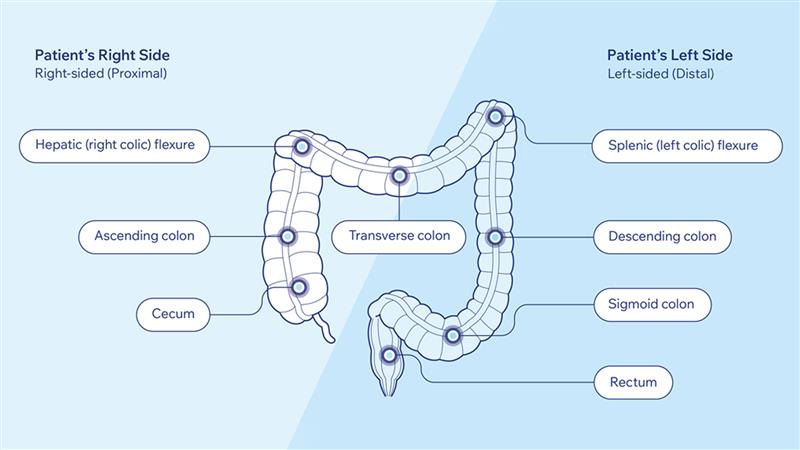
When you hear the phrase “tumor sidedness,” it may sound like a small detail, but in colorectal cancer, whether a tumor starts on the right side or the left side of the colon can significantly influence your cancer’s biology, how it behaves, and which treatments are most effective.
Tumor Sidedness and Biomarkers
Right-sided colon cancer is more often associated with
· MSI-High (microsatellite instability-high), also known as dMMR (deficient mismatch repair)
· Lynch Syndrome (an inherited genetic syndrome of increased cancer risk)
· KRAS gene mutations
· BRAF gene mutations
Left-sided colorectal cancer is more likely to be associated with
· HER2 gene amplification or protein overexpression
· Familial Adenomatous Polyposis, also known as FAP (an inherited syndrome of high CRC risk)
Tumor Sidedness and Prognosis
Left-sided colorectal cancer generally has a better prognosis than right-sided colon cancer, especially at advanced stages (stage III and stage IV/metastatic colorectal cancer). This is due to several factors, including stage at diagnosis, associated biomarkers, and treatment options. Right-sided colon cancer is more likely to spread (metastasize) to the liver and lungs, rather than the lining of the abdominal cavity (peritoneum),whereas left-sided CRC tends to spread to the abdominal lining rather than the liver and lungs.
Tumor Sidedness and Treatment
As expected, surgery is tailored to colorectal cancer location. Surgical treatment of right-sided colon cancer may involve removal of the cecum, ascending colon and/or a part of the transverse colon. Surgical treatment of left-sided colon cancer may involve having part of the transverse, descending, and/or sigmoid colon removed. If the cancer is low in the sigmoid colon, part of the rectum may be removed. If the cancer is located in the rectum, some or all of the rectum is removed.
Chemotherapy and targeted treatment of colorectal cancer can also vary by tumor sidedness, due in part to differences in other associated biomarkers.
· Because right-sided tumors often have MSI-high, immunotherapy is often effective against them. Immunotherapy drugs, like pembrolizumab, nivolumab, or ipilimumab, help the immune system recognize and attack cancer cells more effectively.
· Chemotherapy combined with bevacizumab (a VEGF inhibitor) typically works better than EGFR inhibitors for right-sided colon cancer, even when KRAS, NRAS, and BRAF do not have mutations.
· Left-sided tumors typically respond better to EGFR inhibitors, like cetuximab and panitumumab, which is often combined with traditional chemotherapy
Additional targeted therapy treatment options for both right- and left-sided colorectal cancers may be indicated based on the results of other biomarker testing such as microsatellite stability (MSS) and microsatellite instability (MSI), RAS gene mutation status (KRAS or NRAS), BRAF mutation status, and HER2 amplification or overexpression status.
Tumor sidedness is not a minor detail, it's a key factor that influences tumor biology, behavior, and therapy response. Right-sided and left-sided colorectal cancers are truly distinct diseases in many ways. By understanding where your tumor began and what its biomarkers reveal, you and your care team can make treatment decisions that are more precise, more effective, and better aligned with your individual cancer biology.
For more information about tumor sidedness, please visit our Know YourBiomarker Tumor Sidedness page and check out the other blog posts in the series.