
Know Your Biomarker: HER2 Impact in Colorectal Cancer
In our previous blog, we introduced HER2 and explained how this gene can act as an oncogene—sending signals that drive cancer cell growth when it becomes altered. While HER2 is best known for its role in breast cancer, it can also appear in a small subset of colorectal cancers.
But what does it actually mean if a colorectal tumor is HER2-positive? And how does that information affect treatment decisions? Understanding HER2 status is an important part of modern colorectal cancer care because it helps doctors choose therapies that are most likely to work.
What Does “HER2-Positive” Mean?
When a tumor is tested for HER2, the results are usually reported as either HER2-positive or HER2-negative.
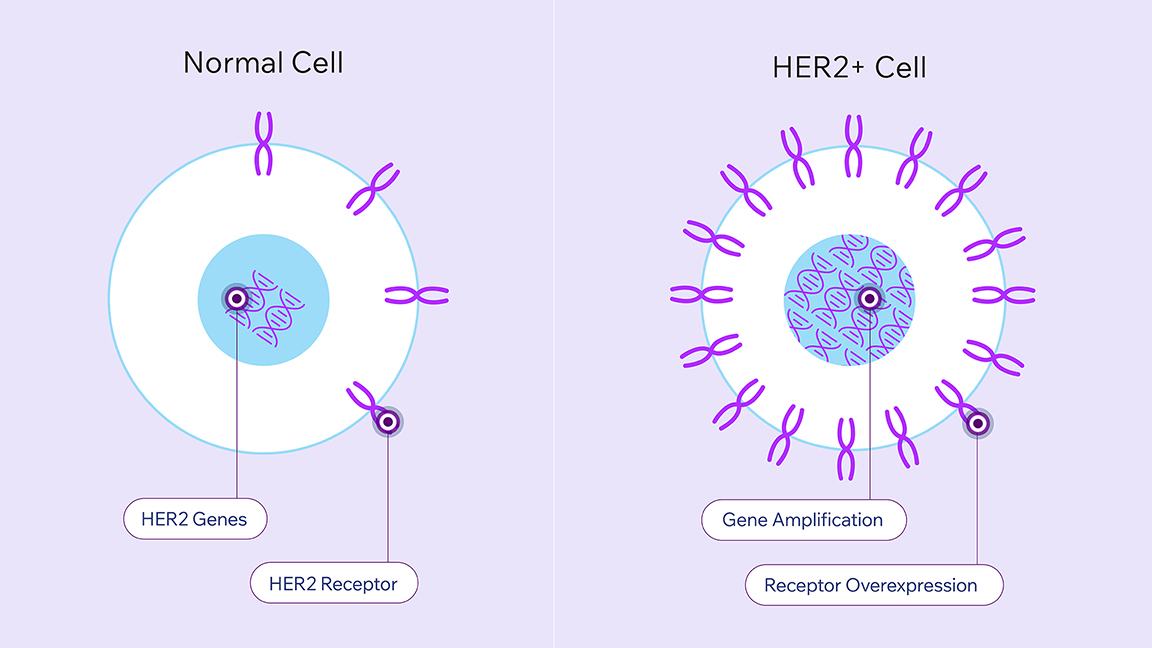
A tumor is considered HER2-positive when it has:
· Too many copies of the HER2 gene (called gene amplification), or
· Too much HER2 protein on the surface of cancer cells (called protein overexpression)
These changes lead to an unusually high number of HER2 receptors on tumor cells. As a result, the cells receive too many signals telling them to grow and divide, which can drive cancer development and progression.
If a tumor is HER2-negative, it means the cancer cells have normal levels of HER2 gene copies and protein expression.
How Common Is HER2-Positive Colorectal Cancer?
HER2-positive colorectal cancer is relatively uncommon. Research shows that about 3–5% of colorectal cancers have HER2 amplification or overexpression.
HER2-positive tumors are more frequently found in colorectal cancers that:
· do not have mutations in other common cancer-driving genes such as KRAS, NRAS, or BRAF
· occur in left-sided colon tumors more often than right-sided tumors
Although this subgroup is small, identifying it can make a meaningful difference in treatment planning.
How Doctors Test for HER2
HER2 status is determined through biomarker testing on a tumor sample.
Testing may be performed:
· on tissue collected during a biopsy or surgery
· through next-generation sequencing (NGS) as part of a larger biomarker panel
· in some cases through a liquid biopsy, which analyzes circulating tumor DNA in the blood
Results may be reported simply as positive or negative, or sometimes with a score (for example 1+, 2+, or 3+) that reflects how much HER2 protein is present in the tumor sample. Higher scores indicate higher HER2 expression.
HER2 testing is recommended for people with metastatic (stage IV) colorectal cancer, where biomarker results can help guide treatment decisions.
Why HER2 Status Matters for Treatment
HER2 is considered both a prognostic and predictive biomarker in colorectal cancer.
That means HER2 testing can provide information about:
· how the cancer may behave
· which treatments may or may not work
For example, colorectal cancers with HER2 amplification are less likely to respond to anti-EGFR therapies, a type of targeted treatment sometimes used for metastatic disease.
However, HER2-positive tumors may respond to HER2-targeted therapies, which are designed to block the HER2 receptor and interrupt the growth signals driving the cancer.
HER2-Targeted Treatments
Several therapies that specifically target HER2 are now being used in colorectal cancer, particularly in advanced or metastatic disease.
These treatments aim to block HER2 signaling, which can slow or stop cancer cell growth.
Examples of HER2-targeted therapies include:
· trastuzumab
· pertuzumab
· tucatinib
· lapatinib
· fam-trastuzumab deruxtecan-nxki
These drugs may be used in combination with each other or alongside other treatments, depending on the patient’s cancer characteristics and previous therapies.
Researchers are also continuing to study HER2-targeted approaches in clinical trials, exploring new strategies for treating HER2-positive colorectal cancer.
The Bottom Line
HER2-positive colorectal cancer represents a small but important subgroup of patients.
Testing for HER2 helps doctors better understand the biology of a tumor and identify patients who may benefit from HER2-targeted therapies. As research continues, these targeted approaches are becoming an increasingly important part of precision medicine in colorectal cancer.
For patients with metastatic colorectal cancer, talking with an oncology team about biomarker testing—including HER2 testing—can help ensure the most informed treatment decisions are made. Download our free HER2 Discussion Guide today.
The HER2 campaign, part of the Know Your Biomarker program, was made possible with support from Pfizer.